Developing an Enterprise Data Model for the Cincinnati Public Library
Jan – Apr 2019
Scenario
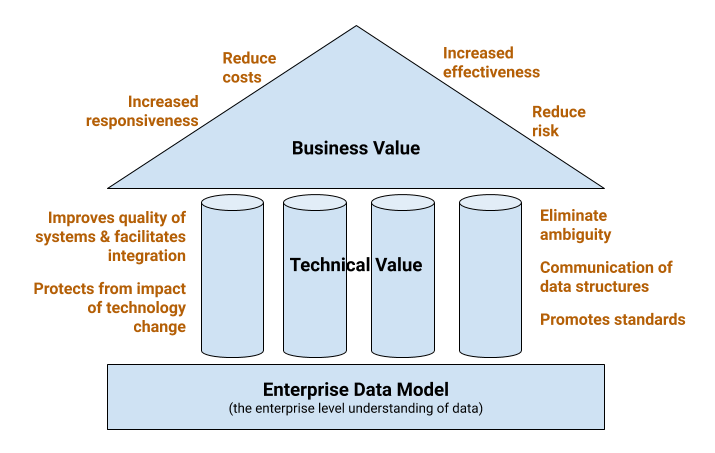
As part of my graduate work in Data Architecture, I analyzed my organization’s business needs using data models, developing a series of artefacts to gain a holistic view of the Library’s value-added information resources. As a continuously-evolving, dynamic organization, PLCH must be able to align its business and IT resources to meet future needs, which is part of the value that a PLCH Data Architecture will bring to the table. Data models provide business value by establishing a high-level understanding of data to bring the organization towards its desired state. Such a model would support the Library’s Strategic plan while enabling its leaders to better meet current and future customer needs.
Alongside the models themselves, I composed a Project Charter for PLCH Data Architecture that formed the high-level plan for implementation and governance and included several outputs:
- Data Governance Council
- Business Glossary
- Conceptual Data Model
- Logical Data Model
Data Governance Council
Governing PLCH organizational data will be an ongoing assurance effort to define and enforce rules for how PLCH data moves through its lifecycle. This governing body should be in place first to ensure the Data Architecture project is implemented in a structured and stepwise manner. Recruitment via the Staff Blog will help educate and promote the Project to staff systemwide.
Business Glossary
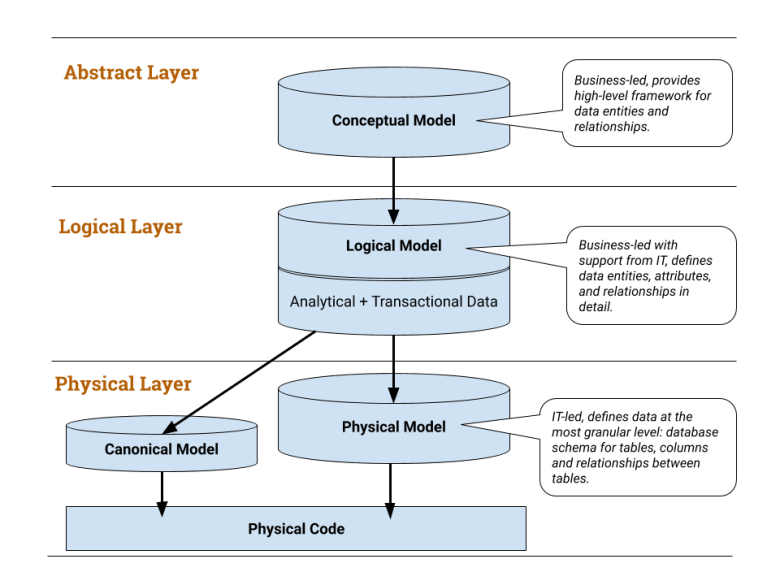
The PLCH Business Glossary will support consistent use of business language, clarify semantic associations between key concepts, and define all the metadata needed by various agencies to find organizational information. This is particularly important for expediency in customer service. Developing an authoritative source of truth for Library Services definitions and associations will ensure that everyone is on the same page when delivering services, conducting programs, and communicating with each other and our customers.
Conceptual & Logical Data Models

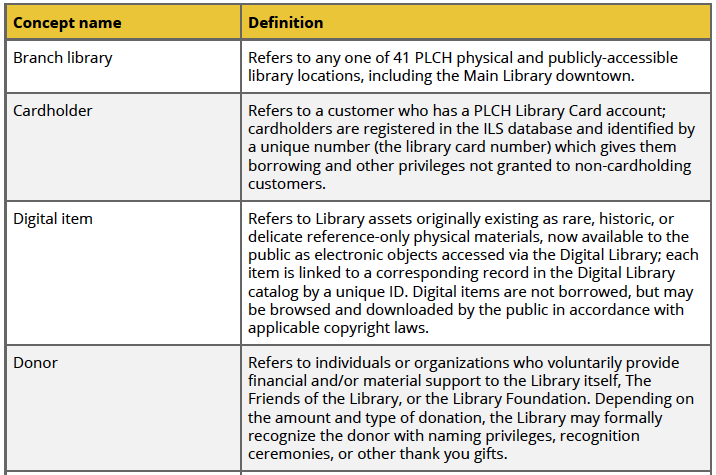
With a working Business Glossary in place, the Project Team can move onto analyzing and designing data structures. Data modeling involves identifying information entities (such as Cardholders), defining their attributes (Name, Address, Birthdate, etc.), and relating these to other entities (Cardholder → borrows→ Laptop).
In the inset for the PLCH Conceptual Data Model, major entities and their relationships are shown at a high-level. The Logical Data Model (below) decomposes entites with added metadata and defines relationships between entities more precisely, using UML (Unified Modeling Language) notation.

PLCH Data Architecture Outcomes
FOR THE LIBRARY
- Realize long-term cost savings by updating isolated legacy systems
- Increase efficiency of workflows and internal processes
- Respond more quickly to opportunities for improvement
- Improve our current business intelligence and analytics capabilities
- Reduce risk with more robust security and disaster recovery management
FOR THE COMMUNITY
- Provide more in-demand and innovative services for customers
- Improve customer service with updated systems that can integrate data more easily
- Better stewardship of public funds
- Collections that are more usable and easily accessible
- Technology resources that are more sustainable, flexible, and customizable
For more details about the Data Architecture project, view my final deliverable and accompanying research paper.
 Anne Sawyer