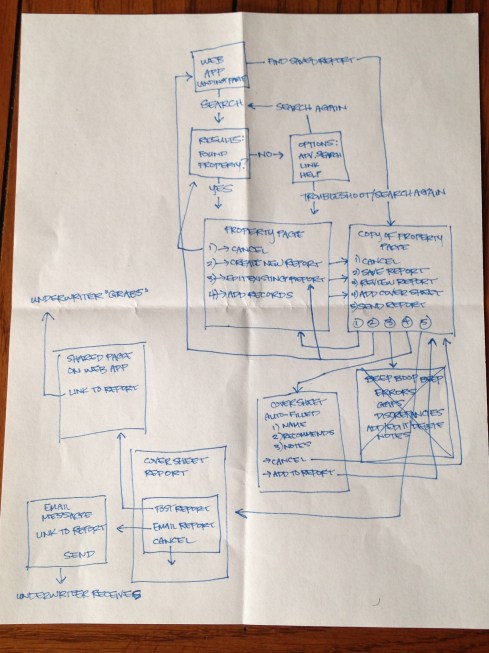
This week’s assignment to create a work flow for a title insurance company presented some unique challenges. Much like last week’s Tiny Critique, I had to remember how to draw. Drawing used to be a passion of mine (especially as a kid), in fact, I even minored in Studio Art in my days at Xavier University. But since matriculating in 2006, I have rarely put pencil to paper. Even writing by hand has become somewhat unnatural for me, since in my work I type just about everything. I even have an Excel spreadsheet rigged up on my desktop that I use to copy, paste, and print out library card numbers for patrons, precisely so that I don’t have to spend the extra time looking up and down between a computer screen and paper while I write down an 8-digit number. The spreadsheet also functions as a handy little poka yoke, since it prevents me from transcribing the card number incorrectly and also removes the barrier of unreadable handwriting.
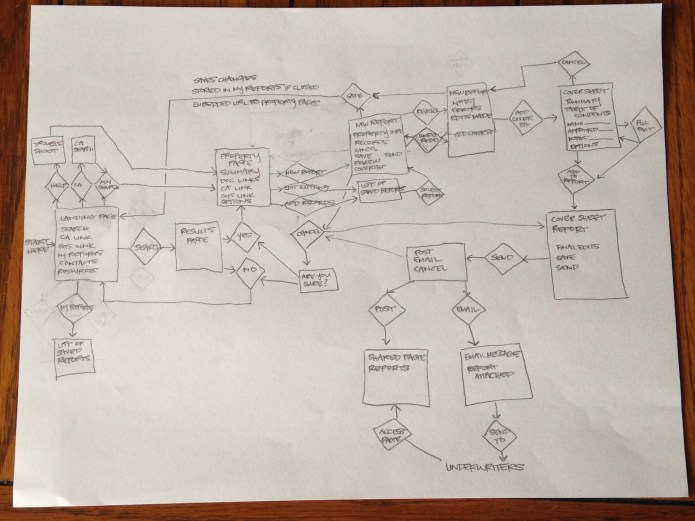
What is a title insurance agency, and what is the point of title insurance? This was another early challenge of mine. I remember going to the bank back in 2012 to get a prequalification letter for a mortgage, and the banker guy explained each item in this long list (I swear there was like 20 different types of fees on this thing) of requirements that would need to be included in the loan. I recall title insurance being among them, and the curmudgeonly miser in me couldn’t help but question it’s inclusion: why would I need an entire insurance policy just for the property title? As long as I did my homework as a potential homebuyer and examined the property history, I shouldn’t have to pay some insurance vampire. In fact, the whole process kind of disgusted me, which is why I am still renting today. The real estate/mortgage system seems set up to swindle people and make them think they can have something they really can’t afford. The man who would become my husband and I decided, after going through this labyrinthine rigmarole up to the point of making an offer and having two property inspections, that we would not buy real estate until we could afford to pay for it outright, with cash. The point of this rant is to illustrate the challenge in removing myself from questioning the need for the very existence of title insurance long enough to think about helping people who work for such a company.
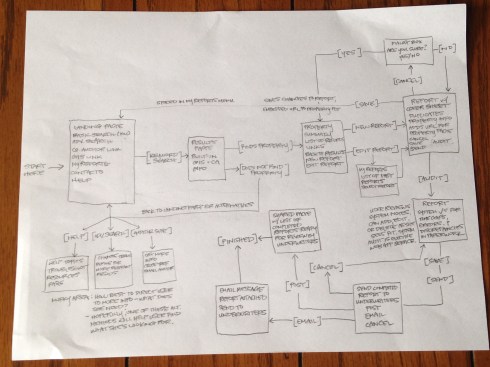
I was also challenged this week to think in the scope layer of the user experience process. As I started brainstorming I struggled with understanding how to think in terms of scope without also thinking about layers of structure and skeleton. I went through several sheets of paper iterating my flow ideas, mainly with boxes and notes. I am really glad I attended our weekly VOH meeting, because my default English major setting had already typed a 5-page essay explaining and justifying the steps in my flow process, and was planning on more-or-less grafting the hand-drawn flow chart onto this document. While typing everything out beforehand helped me think through possible scenarios, answer questions, and prioritize steps within the flow, it would not be enough to produce a streamlined flow that could stand alone. Paring down my copious notes to what I could fit hand-written onto a 9″ x 12″ piece of sketchpad paper helped me evaluate elements of the flow because I could see it more clearly. I realized that what I was doing was working from the complex (details) to the simple (big picture). This funneling down from all possibilities to essential needs was important and necessary to creating a flow that flows.
Look at me citing my sources a la APA mode:
Garrett, J.J. (2011). The elements of user experience: user-centered design for the web and beyond (2nd ed.). Berkeley, CA: New Riders.
 Anne Sawyer