The more I learn about design, the more I find myself applying it in work settings and everyday life in general. Earlier this week for example, I was collaborating with the Children’s Librarian at my one of my assigned branch locations about an upcoming craft program she was designing for preschoolers. She created a mock-up of the craft, a simple design involving colored construction-paper shapes pasted onto a white paper plate. She wasn’t confident with the results, and asked me if I could tell what the design was supposed to represent.
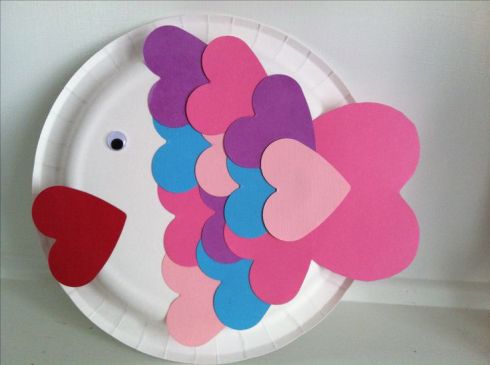
At first glance, I guessed incorrectly (“A butterfly?”), and only after receiving feedback from the librarian was I able to come up with the correct answer (“Ah-ha, a fish.”). Because of my recent immersion in design principles, I was able to provide her with an easy design fix for her problem, based on the Gestalt principle regarding the Figure/Ground relationship (“What if you colored in the inside circle of the plate? Then it will look more like the figure and less like the background.”). As a result, not only was my coworker able to plan her upcoming program to her satisfaction, she was able to keep her original design idea with a very simple tweak, thus saving her time to work on other tasks. For myself, I was gratified to provide a solution to a problem that helped her in a meaningful way (I kind of live for that sort of thing, after all).
In reciprocity, this same Children’s Librarian helped me out with my own design problem. During a slow hour at the circulation desk, I asked her if she could be my subject for a quick usability test (In truth, I didn’t use the term “usability test,” rather, I asked if she wouldn’t mind being my guinea pig). I was tinkering with how to re-frame the question posed by our Tiny Critique assignment, and was curious how an actual, live human being other than myself would respond to the dialog box if it asked the user:
How would you like to monitor this company?
(Check all that apply.)
Her response was interesting and made me re-think the need to supply an additional line of text that essentially instructs the user how to proceed with answering the question. She told me that when she sees a line of text in parentheses she tends to skip over it as superfluous information that doesn’t require close reading. I valued her input, and told her so, as this interpretation of parenthetical text would have never even occurred to me. I didn’t like the idea of including the extra line of text because it meant there would be more “stuff to read” and render the design less elegant, but I didn’t know how not to include it. The problem resolved itself later that evening, but it might not have happened at all if I had not sought out direct user input. I also must give my husband credit here: he was my primary sounding board for working through this iterative process, providing thoughtful outside perspective and helping me to talk through my decisions while keeping my rationale judicious.
I’ll end here by noting that this week’s (Check all that apply) conundrum has given me insight into my parenthetical peccadilloes, and serves as a good reminder that not everyone thinks about linguistic devices the same way. One person’s witty aside or helpful note is another’s blather or distraction. Furthermore, as designers we would do well to remember that parentheses by definition interrupt a syntactical construction.
 Anne Sawyer